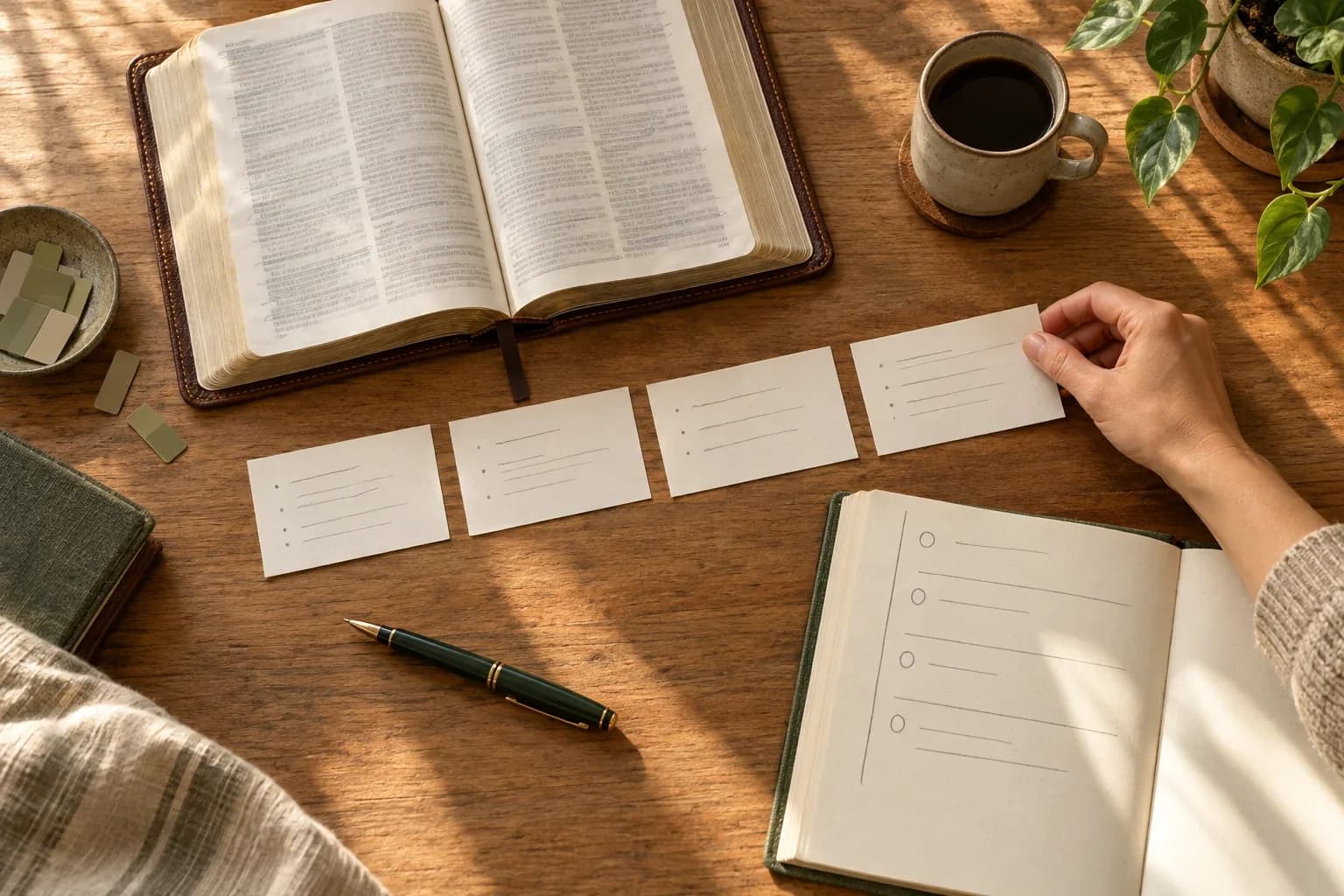



You begin a plan enthusiastically, miss a few days, and feel you should give up. Or you set aside time for Scripture but spend the session deciding what to read. A simple routine can support continued study without becoming an impossible demand.
A useful Bible-study routine combines a realistic time, a reading sequence, a study question, and room for prayer and application. Planning serves engagement with God's Word; it does not measure your worth before God.
Choose a sustainable rhythm
Consider work, family care, energy, and actual limitations. Twenty minutes on several days may be more workable than a daily hour planned without regard for responsibilities.
Psalm 1:1–3 presents delight and meditation in God's instruction as part of a life shaped by him. It does not establish one schedule or format for every reader.
A possible beginning
Try two or three weekly sessions and a brief time to revisit notes. Adjust after observing what works. This suggestion is not a universal spiritual rule.
Decide the next reading before finishing today's
Choosing a book and progressing in sequence reduces the need to find a new subject every day. It also preserves connections between passages.
You could begin with Mark 1. Read the chapter as a larger unit and record questions. Then select a section for closer investigation.
You need not solve everything before continuing. Keep a question list and distinguish what prevents understanding the main argument from what can be researched later.
Use a short structure for each session
Prepare your attention
Gather a Bible, notebook, and reference resource if needed. Reduce possible interruptions and pray for understanding and humility. Do not wait for perfect conditions to begin.
Read and ask one question
Observe the passage and choose a specific question. In Mark 1:14–20, for example, examine how Jesus' announcement relates to the calling of his first disciples.
Do not automatically turn the account into a command for everyone to leave their job. Understand the narrated circumstances before developing an application.
Record a response
Write one text-supported conclusion, one unresolved question, and a response in prayer or action. Brief notes can be enough; copying lengthy commentaries is not required.
An adaptable sample week
- First session: read Mark 1 and identify its main scenes.
- Second session: study Mark 1:14–20 and formulate an interpretation question.
- Third session: review your conclusion, research one uncertainty, and respond with prayer and a consistent action.
The next week, continue through the book or investigate something needing attention. A plan should encourage continuity rather than create a growing debt of unread pages.
What if the routine breaks down?
Resume with the next manageable unit. You do not need to compensate for every missed day with an exhausting session. If difficulty persists, reconsider the schedule, passage length, and volume of material.
Audio, another person's help, and accessible explanations may support learning. Formats can change with life's seasons. For connecting study and prayer, see our article on study and devotion.
Evaluate the routine by learning
After a few weeks, ask whether you understand the text better, identify questions, and respond more thoughtfully. James 1:22–25 reminds us that hearing and doing belong together.
Choose your next passage and a realistic time today. Consistency grows through honest returns to God's Word, not an image of discipline that must appear perfect.
Biblical references are discussed through paraphrase; schedules and exercises are adaptable suggestions.