


You begin reading a book of the Bible with good intentions, come across a familiar passage, and soon move on to another subject. By the end, you remember a few verses but cannot explain the book's message. More notes alone will not solve that difficulty. You need to follow the path the text itself takes.
To study a biblical book from beginning to end, read it as a whole, examine its context and genre, identify its sections, and consider each passage in relation to the whole. Then summarize the message and turn what you have learned into a faithful application. The process calls for attention and repetition, rather than knowing every answer in advance.
This Bible study guide uses Philippians as an example. The method can be adapted to other books while respecting the differences between letters, narratives, poetry, and prophecy.
1. Choose a book and define a study question
If you are getting started, a short book makes it easier to follow the sequence without losing the big picture. Philippians has four chapters and offers a manageable starting point. That does not make every passage simple; it makes repeated reading of the whole more practical.
Instead of trying to settle every question at once, ask: what does this book communicate to its first readers, and how does that message guide Christian living? Note how much time you can devote to studying. A realistic plan helps more than a goal that only works during an ideal week.
Respect the literary genre
A letter presents arguments, instructions, and relationships between its sender and recipients. A narrative recounts events through characters and conflicts. Poetry uses imagery that should not be treated as technical description. Prophecy requires attention to its audience, circumstances, and language.
These differences affect the questions we ask. We should not turn every narrative into a command to repeat an action, or every poetic image into an unconditional personal promise.
2. Read the entire book before studying the details
Make a first reading to notice how the message develops. When possible, read a short book in one sitting. Divide longer books into sections and keep track of their sequence. There is no sacred amount of time for this stage.
Record only what is most important:
- Who is speaking, and to whom?
- What situations or problems appear?
- Which words, themes, and contrasts recur?
- Are there clear changes of subject, setting, or speaker?
- How does the book begin and end?
Do not stop at every uncertainty. Mark questions to investigate later. At this stage, you are building a map rather than filling every gap.
3. Gather context without inventing information
Begin with clues provided by the text itself. In Philippians 1:1–14, the greeting identifies senders and recipients, and Paul describes his imprisonment and the readers' partnership in the gospel. These observations help us understand the letter without requiring a complete historical reconstruction.
When consulting an introduction or commentary, distinguish explicit information, well-supported conclusions, and debated hypotheses. If a date or location cannot be established confidently, record the uncertainty rather than treating it as an essential settled fact.
Let tools serve your reading
A clear translation, a notebook, and an edition that shows paragraphs are enough to begin. Commentaries and dictionaries can clarify difficulties, but they do not replace your own observation. Consult them to investigate a specific question, rather than simply copy someone else's conclusion.
Section headings and chapter and verse divisions help locate passages; they should not be confused with the author's argument. A line of thought may extend across one of those divisions.
4. Build a provisional outline of the book
After the overview, group passages that address a common subject. Write a brief heading for each section and consider why the next passage follows it. Your outline is a study tool, and it can change as you reread.
An initial map of Philippians might highlight gospel partnership amid hardship, community life shaped by Christ, confidence placed in him, and closing instructions. This summary neither exhausts the letter nor establishes its only possible outline.
Notice, for example, how Philippians 2:1–11 connects concern for others with Christ's humility. The teaching about Jesus contributes to the call to community life; it is not a parenthesis detached from the appeal.
5. Study one paragraph at a time without losing the whole
In each session, reread the passages before and after your chosen section. Look for connecting words, repetitions, questions, examples, and conclusions. Ask what the author is asserting and how that assertion functions within the larger message.
A simple study sheet can have four fields:
- Observation: what is actually written?
- Interpretation: what does it communicate in this context?
- Questions: what still needs checking?
- Application: how can I respond faithfully to the message?
Distinguish the text from your first impression
A sentence may remind you of a personal experience without having been written to describe it. Record that association as your own reflection, then check whether the application agrees with the passage's meaning.
In Philippians 3:4–11, Paul contrasts his credentials with confidence in Christ. Treating the passage merely as encouragement to improve a résumé would miss its central contrast.
An example: reading Philippians 4:13 within the argument
Philippians 4:10–20 addresses contentment in changing circumstances and the help Paul received. Strength in Christ is presented in that setting. It is not a guarantee of fulfilling every ambition or winning every competition.
An application might involve learning to depend on Christ in both plenty and need, and recognizing the importance of mutual care. This reading preserves hope without turning a verse into a promise its paragraph does not offer.
The example shows why whole-book study helps: a familiar passage can be heard within the conversation to which it belongs.
A practical plan for completing the study
For a short book, try this sequence and adjust the pace to your circumstances:
- First session: read the whole and note your overall impression.
- Second session: reread and identify context, themes, and main sections.
- Following sessions: examine small sections using the four-field study sheet.
- Summary session: reread the book and check your outline against what you learned.
- Follow-up: evaluate one application and record questions needing further study.
This is an organizational suggestion, not a biblical rule. Longer books and difficult passages may require additional sessions. If you miss a day, resume the sequence; you do not need to give up or rush to catch up.
When you finish, summarize the book's message, the main movements of its argument, and what changed in your understanding. Identify which conclusions are clear and which remain provisional.
Turn understanding into a faithful response
Responsible application considers the distance between the first recipients and our circumstances. Ask what truth about God, instruction, or example the passage presents, and how it speaks to concrete attitudes today. Not every passage calls for the same immediate action.
You may need to ask forgiveness, reconsider a priority, give thanks, serve someone, or keep studying a difficult question. Knowing a book does not give you permission to pressure others with interpretations you have not yet checked.
To explore this care further, read Why context matters in Bible study.
Complete Bible studies are not measured by the number of pages filled. The purpose is to understand Scripture more clearly and respond to God with faith and obedience. Choose a book, prepare your first reading, and begin with an honest question. Understanding grows as we return to the text and allow it to correct our first conclusions.
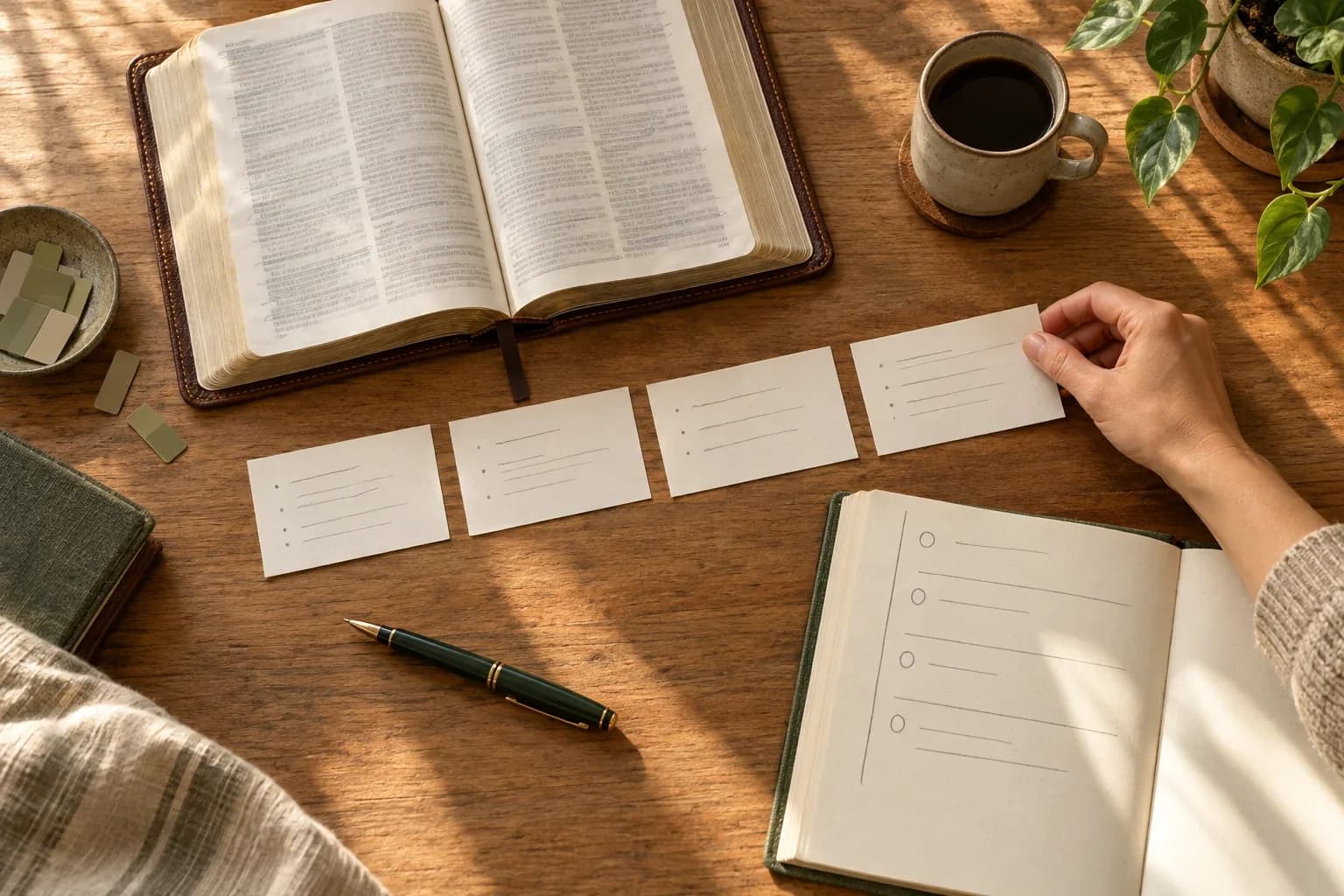
Reading note: the explanations are original paraphrases and applications, not direct quotations. The links lead to the World English Bible, an edition its publisher identifies as public domain. Read the complete chapters in your Bible; the cover is illustrative and was generated with AI.